



Menu


 Sieun Jeon ㅣ
 Approval 2026-03-11 |
 No.22 ㅣ view : 290


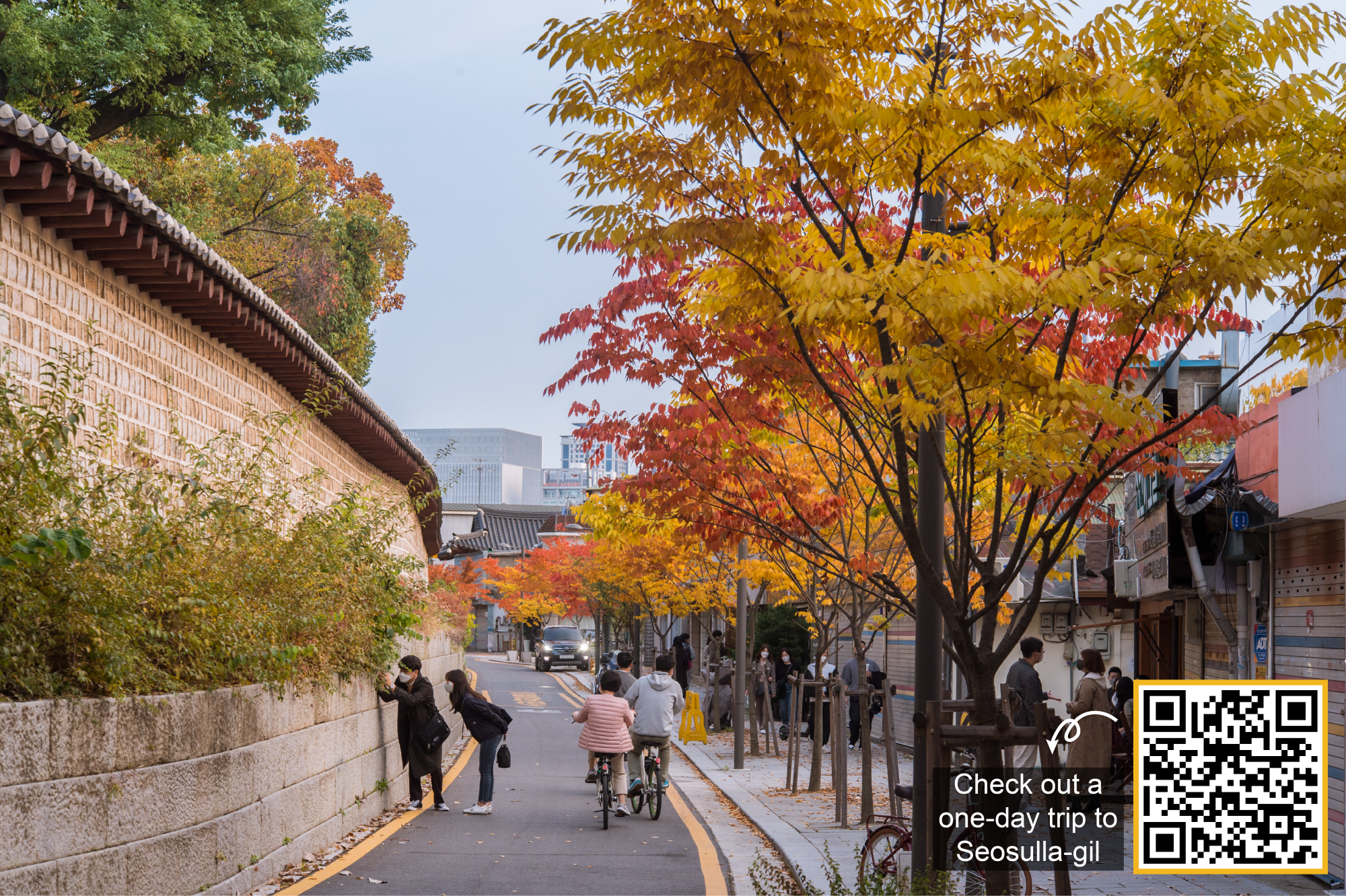
Seosulla-gil Stone Wall Walkway Photo ©Visit Seoul
Have you ever heard of the Seosulla-gil Stone Wall Walkway?
Seosulla-gil, the western path along the wall of Jongmyo Shrine near its main gate, Oedaemun, is now more widely known as a “sensibility café street.” Since it connects closely to Ikseon-dong, it is common to see young people strolling through the area and stopping to take photos. However, it feels insufficient to view the area as merely a trendy hotspot. Seosulla-gil is also an important historical remnant of how Hanyang (the capital of the Joseon Dynasty) was once designed and maintained.
The name “Seosulla” literally means “patrolling (sulla) the west (seo).” In other words, this path originally served as a route for guards to patrol the outer boundaries of the palace. Walking along the outside of the palace stone walls, they monitored the surrounding area, making Seosulla-gil part of the city defense system during the Joseon period.
Seosulla-gil and Its Connection to Jongmyo Shrine
Seosulla-gil’s historical significance becomes even clearer when viewed in relation to Jongmyo Shrine, a royal ancestral shrine in which the spirit tablets of past kings and queens of the Joseon Dynasty are kept. The shrine symbolized the legitimacy of royal authority. The rituals performed there were not merely ceremonial events but essential national practices that helped maintain social and political order. For that reason, Jongmyo was regarded as a sacred space. As a result, the construction of private houses or commercial buildings near the walls was restricted, and a buffer zone existed between Jongmyo and residential areas.
Seosulla-gil After Japanese Colonial Rule
However, this order was greatly disrupted during the Japanese colonial period (1910–1945). With the fall of the Joseon Dynasty and the dismantling of the palace security system, Seosulla-gil lost its original function as a patrol route. An even greater change appeared in the nature of the space itself. The Japanese colonial government sought to weaken the authority of the Joseon royal family and traditional institutions, and the palaces were no longer regarded as the center of national power. As a result, areas surrounding Changdeokgung Palace began to transform from controlled palace-centered zones into ordinary urban residential spaces where citizens lived their everyday lives.
As the population of Gyeongseong (Seoul’s former name) rapidly increased, houses and shops were built around Jongmyo as well. The Jongmyo stone wall, except for certain sections, began to lose its presence amid the city’s expansion.
The Return of Seosulla-gil
In the 1990s, Seoul’s urban policy gradually shifted away from development-oriented planning toward the preservation and restoration of historical and cultural spaces. The redevelopment of the Jongmyo area was carried out within this broader trend, and the path that once ran along the walls re-emerged to become the space now widely known as “Seosulla-gil.” In the end, Seosulla-gil is not a newly created road, but rather a case in which the boundaries and routes of the city, continuing from the Joseon era, have resurfaced within modern Seoul.
Let’s take a short day trip to Seosulla-gil!
For those who would like to walk along Seosulla-gil for themselves, The SeoulTech organized a one-day travel itinerary on Google Maps, centered around Seosulla-gil and nearby attractions worth visiting. As the new semester begins, it may be a great idea to take a short trip with new friends and enjoy both history and atmosphere in the heart of Seoul.
Reporter
Sieun Jeon
cherryjeon06@seoultech.ac.kr


 Comment 0
 Posts containing profanity or personal attacks will be deleted
 HOME
HOME



 Korean Bingsu: A Sweet Tradition of Summer
 2026 Hwaetbul-Je
 Inside SeoulTech’s Sunglim Global Kitchen
 2026 Major Fair: Helping Students Choose Their Major
 COEX Exhibition: Media and Mechanical Engineering