



Menu


 Myungjae Lee, Somin Hong ㅣ
 Approval 2026-01-12 |
 No.21 ㅣ view : 362


For students at SeoulTech, there is a mandatory requirement for graduation called Capstone Design. Conducted over a period of one semeseter to a year, depending on the department, this long-term effort involves students working either individually or in teams to complete a final project or thesis that utilizes the specialized knowledge they have accumulated throughout their undergraduate studies. As the fall semester drew to a close, The SeoulTech interviewed several students who undertook Capstone Design.
* The names of the students who requested anonymity are not specifically mentioned in the article.
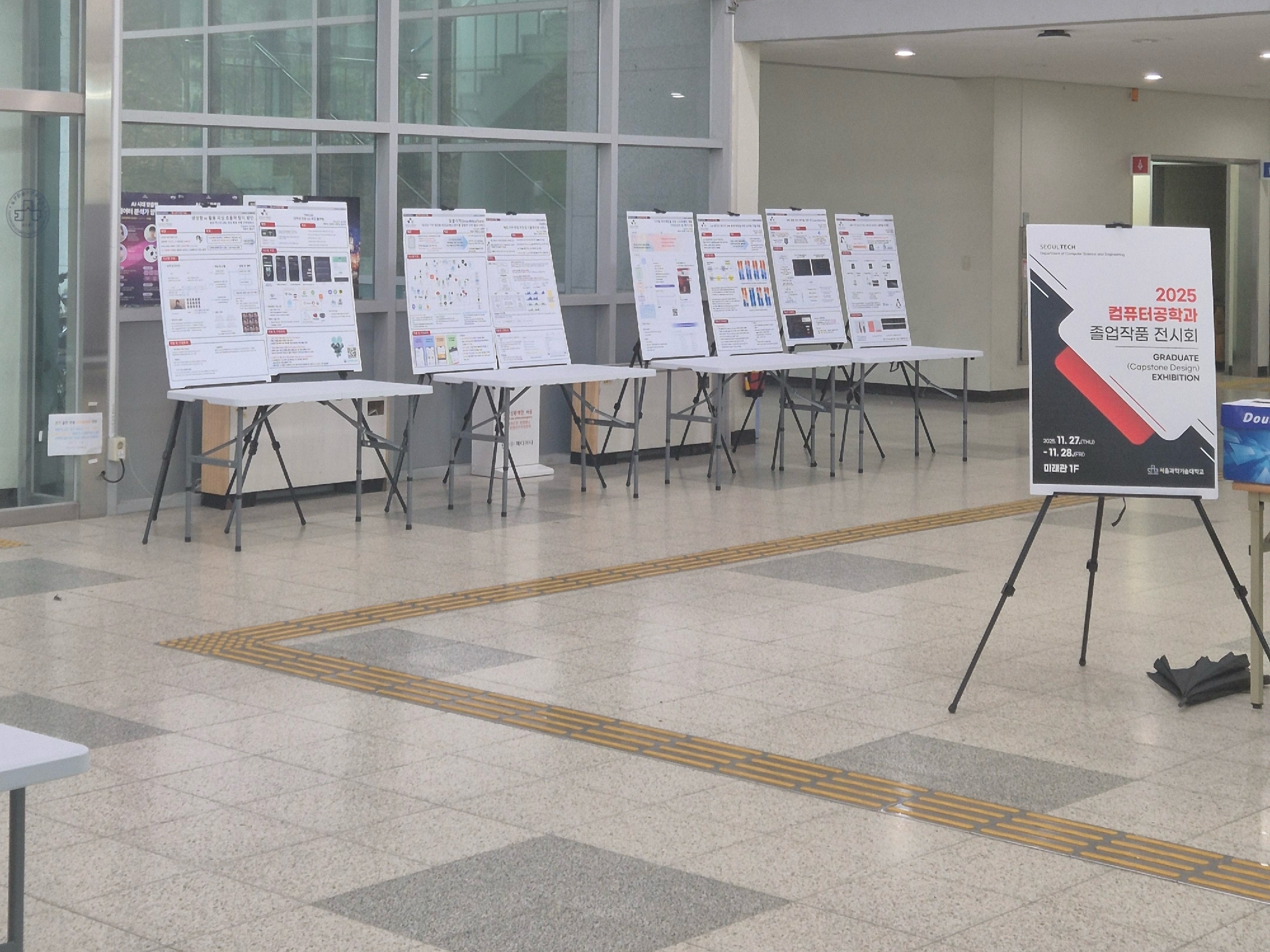 Exhibition of Computer Science and Engineering
Hands-On Skills, Teamwork, and Administrative Support
Students enrolled in STEM (Science, Technology, Engineering, Mathematics) programs, such as those of the College of Engineering and the College of Information and Communication Engineering, are typically assigned an advisor and then spend a year working on a team project to create a prototype in a specific field, which is then formally evaluated. Student A, who took Capstone Design in the Department of Electrical and Information Engineering this year, shared positive reflections, stating: “I gained practical skills like soldering and webpage creation essential for actual project implementation. This experience took me beyond textbook theories.” However, he also said that there were practical difficulties. He pointed out the need for improvements in the support structure, stating, “Material cost support was provided twice, each time 400,000 won, but the timing of the second support coincided with the outside project completions, forcing me to spend my own money.” He emphasized that, students from College of Electrical and Information Engineering are advised to contact their professor in advance to ensure their program operates successfully. If one fails to reach out, the ones without designated team members and professors are grouped together arbitrarily. In this case, the unwelcome situation may arise where one must work on a project for an entire year being with a random professor and unwanted team members. He also added, “Coordinating conflicts among team members over the long period of a year was not easy, and for upperclassmen urgently preparing for employment, the project duration can feel somewhat burdensome.”
The Preparedness Gap
Student B from the Department of Mechanical Systems Engineering adapted relatively easily to the project. Currently active as an undergraduate research student, he stated, “I am developing a walking robot simulation based on a research paper I wrote, and simultaneously preparing for both the presentation and demonstration.” He said that Capstone Design made him keenly aware of his impending graduation, feeling he had taken a step closer to his career and employment. However, Student B also noted with regret that “students whose career paths are unclear or who aren’t affiliated with a lab often suffer greatly, starting with selecting a topic and enduring the process of carrying it through for a whole year.” Student B’s opinion highlights that the difficulty level of Capstone Design varies significantly based on each student’s individual circumstances.
 Exhibition of Creative Writing
Capstone Design in Arts and Humanities
The Capstone Design program in the College of Arts and Design stands out in that it showcases works prepared over a year through a large-scale graduation exhibition. Student C, who participated with the theme ‘AR-based interior solutions for people struggling with plant care,’ stated, “The process of incorporating new technology was interesting, but the burden of exhibition costs and the tight schedule were major difficulties.” They also reflected, “Being immersed in a single theme for an entire year meant overcoming periods in which my interest waned or the topic felt incompatible with my interests.”
At the College of Humanities and Social Sciences, Capstone Design programs involve thesis writing or creative works tailored to their department’s requirements. For instance, Capstone Design participants in the Department of Creative Writing create a portfolio containing their own writing and then set up a personal exhibition space to display it. While they could simply show the book, many students go further by thoughtfully incorporating various experiential elements and visual attractions. This allows them to create a space that uniquely expresses both themselves and their work. Preparing for the exhibition presents its own challenges. In the process of compiling the book, they must use InDesign, a design program unfamiliar to most students. Moreover, when preparing for the exhibition, three teams are formed: planning, promotion, and installation. Coordinating opinions and reaching consensus among these teams also requires significant effort.
“It was very stressful knowing my work would be seen by others,” reflected Student D. “Since I wrote it, I can see its imperfections. I can spot parts that still need improvement. But the deadline meant I couldn’t keep revising it forever. I had to submit my writing after making as many corrections as possible. The biggest worry was presenting this still imperfect work to everyone.”
Capstone Design serves as both a graduation requirement and a social experience before students enter the workforce. While students cultivate practical skills and teamwork through this process, challenges like cost issues and balancing it with career paths remain unresolved institutional challenges for the university. These issues need to be addressed thoroughly by SeoulTech’s continuous attention and strenuous effort, to maintain Capstone Design’s purpose—as a bridge between academic knowledge and real world application.
Reporters
Myungjae Lee
swk08085@seoultech.ac.kr
Somin Hong
hongsomin@seoultech.ac.kr


 Comment 0
 Posts containing profanity or personal attacks will be deleted
 HOME
HOME



 Korean Bingsu: A Sweet Tradition of Summer
 2026 Hwaetbul-Je
 Inside SeoulTech’s Sunglim Global Kitchen
 2026 Major Fair: Helping Students Choose Their Major
 COEX Exhibition: Media and Mechanical Engineering