



Menu


 Seongbeom Hong ㅣ
 Approval 2026-10-06 |
 No.25 ㅣ view : 5


Hangeul-nal commemorates King Sejong’s creation of Hangeul. Observed annually on October 9, it is a legal holiday in South Korea.
In 1926, the Korean Language Research Society, now the Korean Language Society, designated the 29th day of the ninth lunar month as Gagya-nal and held the first commemoration. The name was changed to Hangeul-nal in 1928.
During the 1930s, the anniversary was converted to the solar calendar because its lunar-calendar date changed every year. After Korea’s liberation from Japanese colonial rule, the government used the Hunminjeongeum Haeryebon to identify the date on which King Sejong announced the new alphabet to the public. The book explains how Hunminjeongeum, the former name for Hangeul, was created and used. It also states that the announcement took place “early in the ninth month.” The government interpreted this as the 10th day of the ninth lunar month. In the solar calendar, that date is October 9, which was later established as Hangeul-nal.
How Hangeul Represents the Korean Language
Before Hangeul was created, the Joseon Dynasty used Chinese characters. Because these could not fully match the Korean language, King Sejong decided to create a writing system for Joseon.
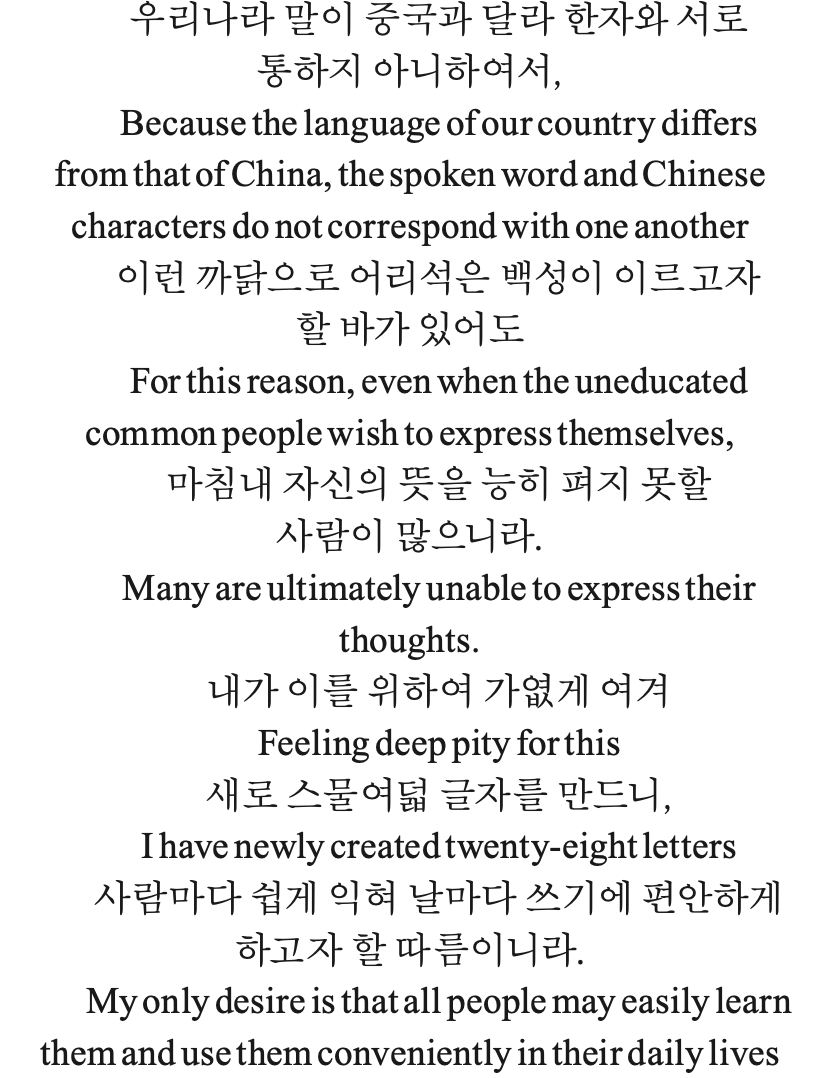
This text is the preface to Hunminjeongeum. It explains why King Sejong created the alphabet and how it should be used. The term Hunminjeongeum re fers both to the alphabet created by King Sejong and to the book that explains the principles of its creation and instructions for its use.
Hangeul thus embodies a spirit of independence through the creation of Korea’s own writing system, a spirit of compassion through King Sejong’s desire to enable ordinary people to express themselves, a spirit of practicality through its ease of use, and a spirit of creativity through the invention of an entirely new alphabet.
Among the consonants, the basic letters (ㄱ,ㄴ,ㅁ,ㅅ,ㅇ) were created by modeling human vocal organs. In addition, vowels embody heaven, earth, and humanity, the foundations of the universe, by representing the sky, earth, and human beings. Korea’s illiteracy rate is reported to be below 1%. This is because Hangeul is a scientific writing system that is easy to read, write, and learn. Hangeul is an exceptional alphabet specifically tailored to the sounds and structure of the Korean language.
Do we still need to study Hanja (Chinese characters)?
Nam Pung-hyun, Professor Emeritus of Korean Language and Literature at Dankook University, explains that over 70% of the Korean vocabulary consists of Sino-Korean words, with academic terms in particular being predominantly Sino-Korean. He warns that without knowledge of Hanja, a deep understanding of concepts becomes impossible, and even with texts written entirely in Hangeul, readers risk falling into a state of “functional illiteracy, where one merely reads the consonants and vowels” without accurately grasping the meaning.
Han Jae-young, Professor of Korean Language and Literature at Hanshin University, explains that there is no strong correlation between the ability to write Hanja by hand and overall Korean literacy. He further notes that rather than persisting with traditional methods of Hanja instruction, a vocabulary-centered approach, one that explains the underlying meanings of Sino-Korean words within the Hangeul writing system, is far more effective. While scholars disagree on whether learning to write and memorize Hanja by hand is necessary, there is a broad consensus that vocabulary education focused on understanding the roots and meanings (morphemes) of Sino-Korean words significantly enhances Korean literacy.
Reporter
Seongbeom Hong
hongsb@seoultech.ac.kr


 Comment 0
 Posts containing profanity or personal attacks will be deleted
 HOME
HOME



 LUPIC: Connection Beyond Study
 From Pen to Page
 Study Korea 300K Project
 In Crisis: Commerce in Gongneung-dong
 Europe’s Summer of Extreme Heat