



Menu


 Sieun Jeon, Sua Lee ㅣ
 Approval 2026-03-11 |
 No.22 ㅣ view : 392


Dating reality shows such as Single’s Inferno, EXchange, Heart Signal, I Am Solo, and Japan’s Badly in Love are gaining popularity, creating the “dating show boom.” In particular, EXchange season 4 ranked first in contributing to paid subscriptions on OTT services and was selected as the No.1 variety show in the 2025 K-Brand Index, proving the strong competitiveness of reality dating shows. Amid this trend, dating programs have gained significant popularity, especially among people in their 20s and 30s. In this article, The SeoulTech examines the background and reasons why reality dating shows have become such a widespread phenomenon these days.
The popularity of dating programs goes beyond simple entertainment, as they strongly affect viewers’ emotions. Recent reality dating shows create strong engagement by narratively structuring participants’ excitement, conflicts, and shifting relationships. Viewers experience emotions vicariously while projecting their own memories and experiences onto the stories, forming a sense of empathy and connection. In addition, within today’s short-form video consumption culture, dramatic and emotionally intense scenes are quickly shared online as memes and topics of discussion, further amplifying a show’s popularity.
Professor Shinhye Lee from the Department of Media and Communication at Pusan National University pointed to the “fulfillment of the desire for relationships” as a major factor behind the popularity of dating programs. She explained, “Reality programs have consistently drawn attention for the past 15 years, but dating-related shows have risen significantly over the past five years,” adding that “the desire for relationships that are difficult to experience in real life is satisfied through media, which becomes a key reason for their popularity.” She also noted, “The most prominent concept in today’s media is authenticity,” highlighting that “when viewers’ desire to see something real combines with provocative production, it can lead to even greater popularity.” These characteristics are also closely connected to the phenomenon of viewers becoming emotionally invested in participants’ changing relationships while comparing their own experiences with those of the participants. Professor Seungyoon Kim from the Department of Counseling Psychology at Catholic University of Pusan stated, “The difference from past dating entertainment shows is that ordinary people, rather than celebrities, appear as participants.” She explained that “this allows viewers to identify with people similar to themselves, which leads to deeper immersion.” She further suggested that “since the participants are mostly in their 20s and 30s, viewers from the same generation find it easier to relate, and romance naturally becomes a shared point of connection.” In order to gain a deeper understanding of why people enjoy watching dating programs, an interview was conducted with a student who frequently watches reality dating shows.
A 24-year-old student surnamed Lim, who attends SeoulTech said she first saw a dating reality show when she was in middle school. She said it felt like watching a romance drama, but it was interesting because it was a reality show based on real dating. She explained that the popularity of these programs comes from the steady use of new ideas, such as bringing in ex-partners, giving prize money, and featuring people who have never dated before. She said it is fun to see diverse relationships and personalities. She also added that it is appealing because, unlike her own dating life, she can look at the situations from a third-person view and judge them more calmly. However, she said that recently, as shows compete for ratings, they use more shocking elements and exaggerated setups, and she feels disappointed because it makes the reality feel less “real.”
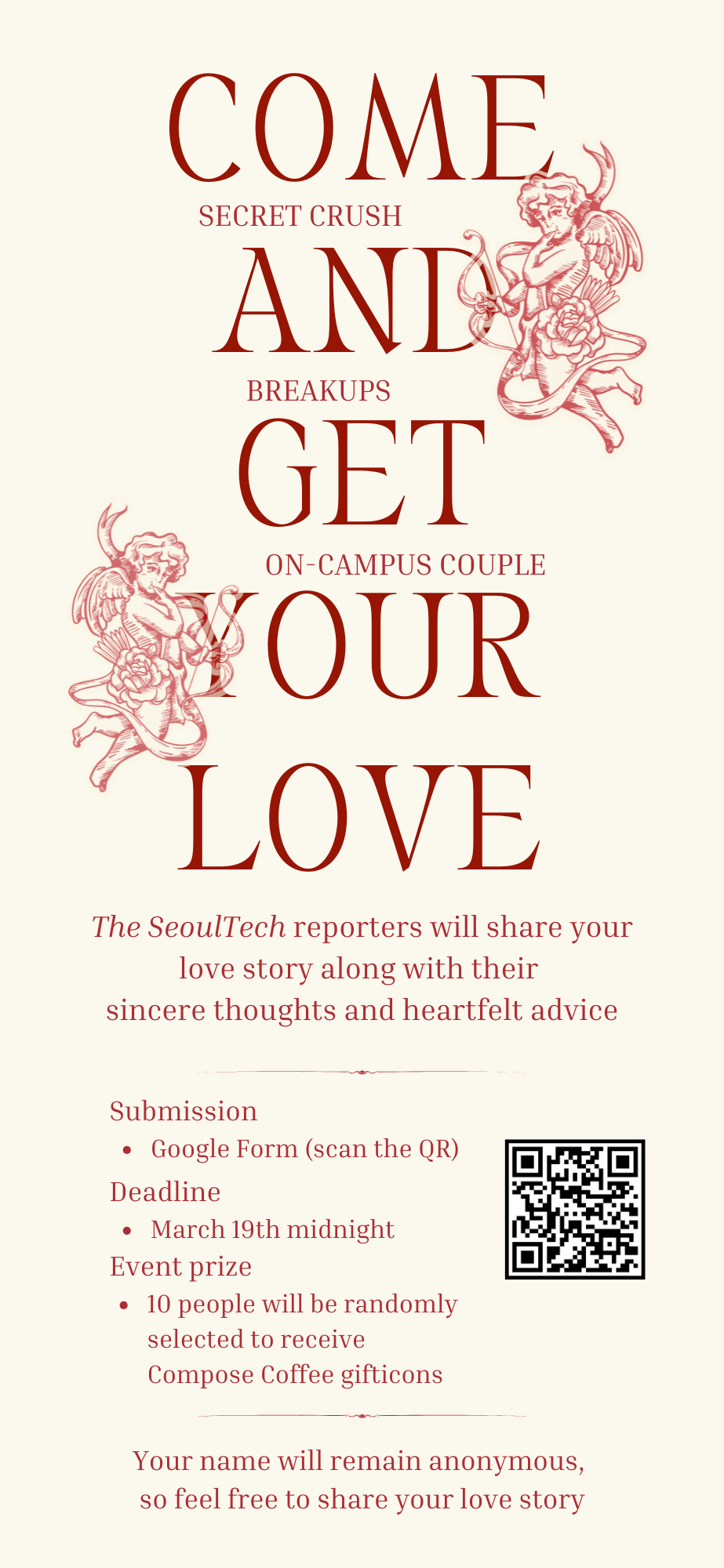
Come and Share Your Love!
Now it’s your turn to be part of the story. The SeoulTech wants to hear your love stories. Any love story is welcome — from a crush or campus couple to a situationship or breakup. If you’d like dating advice, scan the QR code and fill out the Google Form. You may write in Korean or English. Selected stories will appear in the Issue 23, where The SeoulTech reporters will share warm and honest advice. Your name will remain anonymous, so feel free to share your story. As an event prize, 10 participants will be randomly selected to receive coffee coupons. We look forward to hearing from many of you!
Reporters
Sieun Jeon
cherryjeon06@seoultech.ac.kr
Sua Lee
sualee7@g.seoultech.ac.kr

 Comment 0
 Posts containing profanity or personal attacks will be deleted
 HOME
HOME



 Korean Bingsu: A Sweet Tradition of Summer
 2026 Hwaetbul-Je
 Inside SeoulTech’s Sunglim Global Kitchen
 2026 Major Fair: Helping Students Choose Their Major
 COEX Exhibition: Media and Mechanical Engineering