



Menu


 Seongbeom Hong ㅣ
 Approval 2026-10-06 |
 No.25 ㅣ view : 42


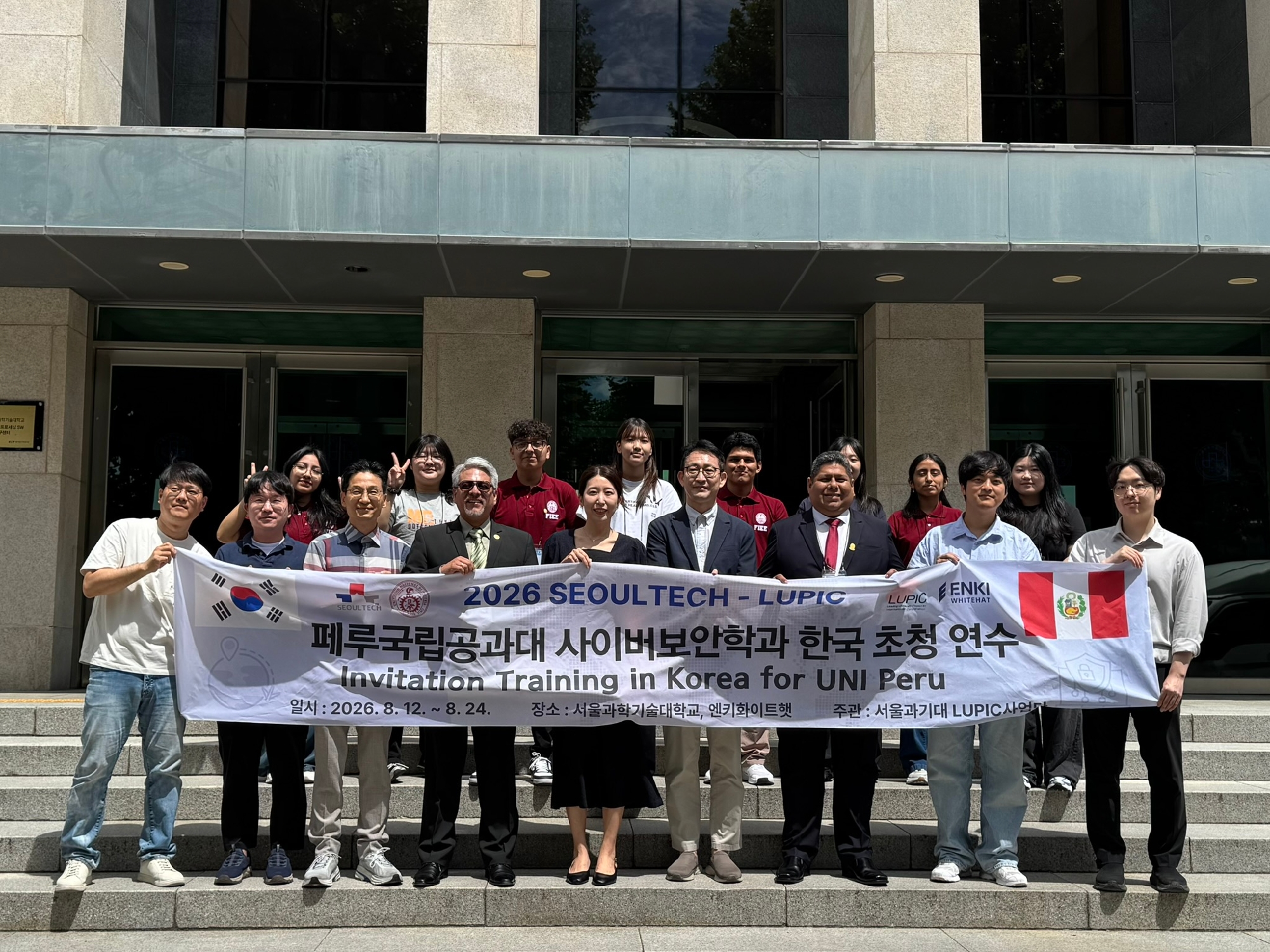
As part of LUPIC (Leading University Program for International Cooperation) at SeoulTech, four students and two professors from the Department of Cybersecurity at UNI (Universidad Nacional de Ingeniería, or the National University of Engineering, Peru) visited SeoulTech for 12 days of academic training, from August 12 to 23. Five SeoulTech students served as student supporters, accompanying participants throughout the visit. The LUPIC team received training at ENKI WhiteHat, a Korean cybersecurity company, and was shown SeoulTech’s facilities. The LUPIC team also spent time playing minigames and visiting various locations in Seoul, besides academic training.
What is LUPIC?
LUPIC, launched in 2012, is a nationwide Official Development Assistance (ODA) initiative led by South Korea’s Ministry of Education. By leveraging the advanced resources and expertise of Korean universities, the initiative supports institutions from developing nations in establishing or revamping academic departments. A number of Korean universities participate in the project to support the development of skilled workforces in partner countries.
SeoulTech’s LUPIC program, partnering with UNI, aims to strengthen cybersecurity in Peru and enable collaboration between Korean and Peruvian students in developing UNI’s Department of Cybersecurity through Korean government ODA. It is a long-term project, planned from April 1, 2020, to March 31, 2027.
The SeoulTech interviewed the Project Director, the SeoulTech LUPIC Project Manager, a UNI professor, UNI students, and SeoulTech student supporters.
Q. What do you think is the most important aspect of this program? What aims does the program have?
A. Project Director Jung Taeho of the Department of Electronic Engineering:
This invitation program is divided into two parts: one for professors and one for students. For professors, the program focused on improving curricula related to managing the Department of Cybersecurity, strengthening practical training, providing guidance on academic papers, and promoting interaction between SeoulTech and UNI. The most important thing is to form a network among professors from the two universities in order to maintain the quality of the Department of Cybersecurity. For students, even though the program is based on academic content, the most important thing is motivation. The program aims not only to encourage students to study cybersecurity in depth, but also to give them an opportunity to explore a wider range of career possibilities and consider their own future paths for skills and career development by observing systems in another country. Of course, this motivation also applies to SeoulTech students. Our intention is to turn peer competition into something positive and productive, with students from each country working and spending a lot of time together.
A. SeoulTech LUPIC Project Manager Lee Boram:
I think the most meaningful part of this program was that Korea and Peru could learn from each other and interact. The program was not only about delivering Korea’s cybersecurity technology and educational practices. Through the training provided by ENKI WhiteHat, participants from both countries were also able to share their experiences and knowledge. Students from the two countries could also gain a better understanding of each other’s cultures. I could see SeoulTech students and Peruvian students having conversations and developing friendships. In that aspect, this program was meaningful because it has laid a cornerstone for continuous interaction between both students and professors from the two countries, rather than just ending as a one-off event.
Q. What do you think about ENKI and LUPIC from an academic perspective, and do they help our two nations to share knowledge effectively?
A. UNI Professor Juan Quillas:
ENKI develops cybersecurity technologies, including a platform that we use at UNI for our classes which is very helpful for developing our students’ skills. Regarding the LUPIC program, I see it as a great boost for both student and teacher develop-ment. The cultural and academic exchange benefits both Peruvian and Korean students and enables us to strengthen cybersecurity knowledge in both nations.
Q. Please feel free to share your thoughts
A. Luciana Paola (Student from UNI):
This cultural exchange made me realize that my own culture is also valuable and precious, just like Korean culture. I not only learned about Korea, but I also learned new things about my own country by comparing both cultures. The academic purpose of this program also had an impact on me. Learning about cybersecurity in Korea increased my interest and motivation to continue learning more about it through my major. It also made me think about new ideas and possibilities that could be developed in Peru in the field of cybersecurity. Even though my main purpose for visiting Korea was to learn about cybersecurity, I also learned about people, culture, and myself. I think that is one of the most valuable elements of this experience.
A. Franco Rafael (Student from UNI):
I am very grateful for the opportunity to be part of LUPIC. This experience was not just about learning new knowledge, but also about meeting new people, experiencing Korean culture, and making friendships that I will never forget.
I believe this experience helped me grow both academically and personally. I hope programs like this continue in the future, as they give students opportunities to learn outside the classroom and strengthen ties between Peru and Korea. I will always remember my time in Korea, especially the friends I made.
Words from SeoulTech Student Supporters
Four of the five SeoulTech student supporters expressed their thoughts and feelings about the program. They said that during their time with Peruvian students, through sincere conversation and the exchange of positive energy, they could learn from each other and build warm friendships. They also mentioned that the program broadened the perspectives of students from both countries and gave them opportunities to share dreams and passions. Furthermore, many commented on how they felt a new motivation to work harder toward their own majors and future goals having learned from Peruvian students’ passion and clear sense of purpose in their majors.
One of the supporters expressed her wish to send this message to their Peruvian friends. “Amigos, los extraño mucho.” (Friends, I miss you all very much.) The program ended successfully, and the team from Peru returned home safely. Although the program has officially concluded, it laid the foundation for continuous exchange between Peru and South Korea.
Reporter
Seongbeom Hong
hongsb@seoultech.ac.kr


 Comment 1
 l 26.10 13:38
 Posts containing profanity or personal attacks will be deleted
 HOME
HOME



 LUPIC: Connection Beyond Study
 From Pen to Page
 Europe’s Summer of Extreme Heat
 Study Korea 300K Project
 Beyond the Storms: What Really Holds Us Back in The Odyssey