



Menu


 Korshunova Anna, Jungwoo Han ㅣ
 Approval 2026-10-06 |
 No.25 ㅣ view : 13


Problem Roots
South Korea is facing a rapid population decline. The nation’s falling birth rate has accelerated this demographic crisis, creating major ripple effects. One of the areas most affected is higher education. As the school-age population shrinks, universities face a growing threat to their survival. According to the Korean Council for University Education, the number of university entrants is expected to drop from 440,000 in 2023 to just 260,000 by 2040.
This crisis is hitting regional universities outside the Seoul metropolitan area particularly hard. Many are struggling to fill admission quotas, raising concerns about potential closures. The decline of regional universities is an urgent national issue, as their survival is closely tied to the economies of their local communities.
Faced with this threat, South Korea is seeking a breakthrough. To offset the falling number of domestic students, the government has recognized the need to open its doors wider to international students. Attracting international students is no longer simply about increasing diversity; it is now a key strategy for sustaining university operations and supporting local economies.
The Status and Challenges of International Students
To tackle this population crisis, South Korea is striving to become a global education hub. Over the past decade, South Korea has seen a steady rise in international students. According to the Ministry of Education, the number of international students stood at 166,892 in 2022. This figure rose to 181,842 in 2023, and by 2024, it had officially surpassed the 200,000 milestone, reaching 208,962. Most of these students come from Asian countries, with China and Vietnam making up the largest groups.
However, despite this significant growth, there are still major challenges. A primary issue is that these students are heavily concentrated in one area. Data indicates that more than half of the international student population resides and studies within the Seoul metropolitan area. This uneven distribution undermines efforts to revive regional universities.
Another critical challenge lies in the long-term retention of these students. Many graduates leave the country after their studies due to language barriers, cult u ral differences, and a lack of f u r ther employ ment support. This highlights the urgent need for better support systems to help retain international graduates.
A New Approach
To combat the demographic crisis and revitalize a struggling higher education sector, the South Korean government launched the Study Korea 300K Project in 2023. Spearheaded by the Ministry of Education, this comprehensive national framework aims to attract 300,000 international students to the country by 2027, effectively positioning South Korea among the top 10 global education hubs. The initiative represents a fundamental shift in national policy: moving away from passive recruitment toward a more proactive and structured approach to attracting and retaining international students.
At its core, the project is designed as a collaborative ecosystem involving universities, local governments, and regional industries. These three groups work together to streamline every stage of the international student lifecycle, from initial global outreach and simplified visa processing to rigorous academic training, localized career development, and post-graduation settlement. By supporting the rejuvenation of regional economies and strengthening competitiveness in high-tech and specialized industries, the Study Korea 300K Project aims to ensure that international students become long-term contributors to South Korea’s economic and demographic future.
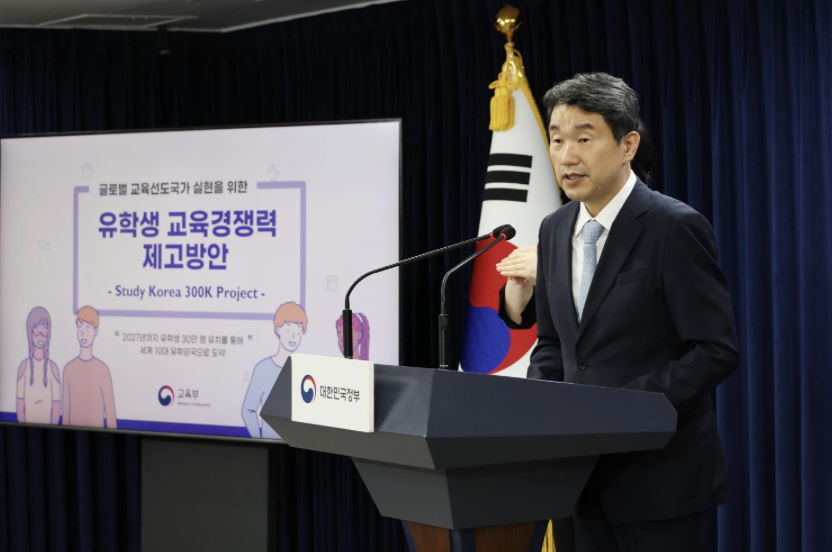 The Study Korea 300K Project press briefing Photo ©Ministry of Education
Key Strategies
The Study Korea 300K Project is built on a strategic framework designed to enhance both the number and quality of international student enrollment. A key pillar of this strategy involves easing visa regulations and expanding employment opportunities, making South Korea a more attractive long-term destination. This includes relaxing restrictions on part-time work hours and creating clearer pathways for post-graduation employment visas in critical industries. Furthermore, the initiative heavily prioritizes regional development, with universities outside the capital area receiving targeted support to attract students to regional universities and local economies. The program aims to bridge the gap between declining provincial populations and international talent.
The second major strategic focus centers on academic innovation and comprehensive campus support systems to ensure student success. Institutions are actively scaling up English-track degree programs while expanding accessible Korean language training courses to ease communication barriers. Recognizing that well-being drives retention, universities are also upgrading campus infrastructures to better support international students. This involves modernizing student dormitories, establishing dedicated international support offices, and creating shared communal spaces like global kitchens that foster cross-cultural exchange and help international students thrive in Korean society.
Remaining Challenges and Future Developments
While the Study Korea 300K Project has successfully accelerated international enrollment, realizing its long-term vision will require overcoming persistent systemic obstacles. Universities and policymakers must work hand-in-hand to address the heavy concentration of students in the Seoul metropolitan area, ensuring that regional institutions genuinely benefit from the influx of global talent. Additionally, creating sustainable post-graduation pathways requires deeper collaboration with local enterprises to improve access to employment information and address lingering cultural or linguistic barriers in the workplace. If South Korea can successfully transition from merely attracting international students to actively retaining and integrating them as valued members of its workforce, the Study Korea 300K Project could serve as a blueprint for navigating demographic decline and securing a globally competitive future.
Reporters
Korshunova Anna
annakor@g.seoultech.ac.kr
Jungwoo Han
han0413@seoultech.ac.kr


 Comment 0
 Posts containing profanity or personal attacks will be deleted
 HOME
HOME



 LUPIC: Connection Beyond Study
 From Pen to Page
 Europe’s Summer of Extreme Heat
 Study Korea 300K Project
 Beyond the Storms: What Really Holds Us Back in The Odyssey