



Menu


 Hyeonseon Namgung ㅣ
 Approval 2026-05-13 |
 No.23 ㅣ view : 233


In recent years, immigration has become one of the most debated issues in the United States. At the center of this discussion is ICE (U.S. Immigration and Customs Enforcement), the federal agency responsible for enforcing immigration laws. Supporters view ICE as essential for maintaining national security and upholding the law, while others argue that its practices raise serious concerns about human rights and the treatment of migrants.
ICE’s Role
ICE has played a central role in implementing the large-scale deportation policies introduced by the Trump administration. Since his return to the White House, President Trump has significantly expanded the budget and authority of ICE. The agency enforces immigration laws and investigates undocumented immigration and cross-border crime. It is also responsible for detaining and deporting individuals who violate immigration laws within the United States. ICE was established under the Homeland Security Act of 2002, enacted in response to the September 11, 2001, attacks. This law created the Department of Home land Security (DHS), under which ICE operates as one of several agencies.
Why Does Trump Support ICE?
The Trump administration has consistently argued that stronger immigration enforcement is necessary to protect national security and economic interests. His administration has emphasized that ICE plays a key role in preventing unauthorized immigration and removing individuals who violate immigration laws.
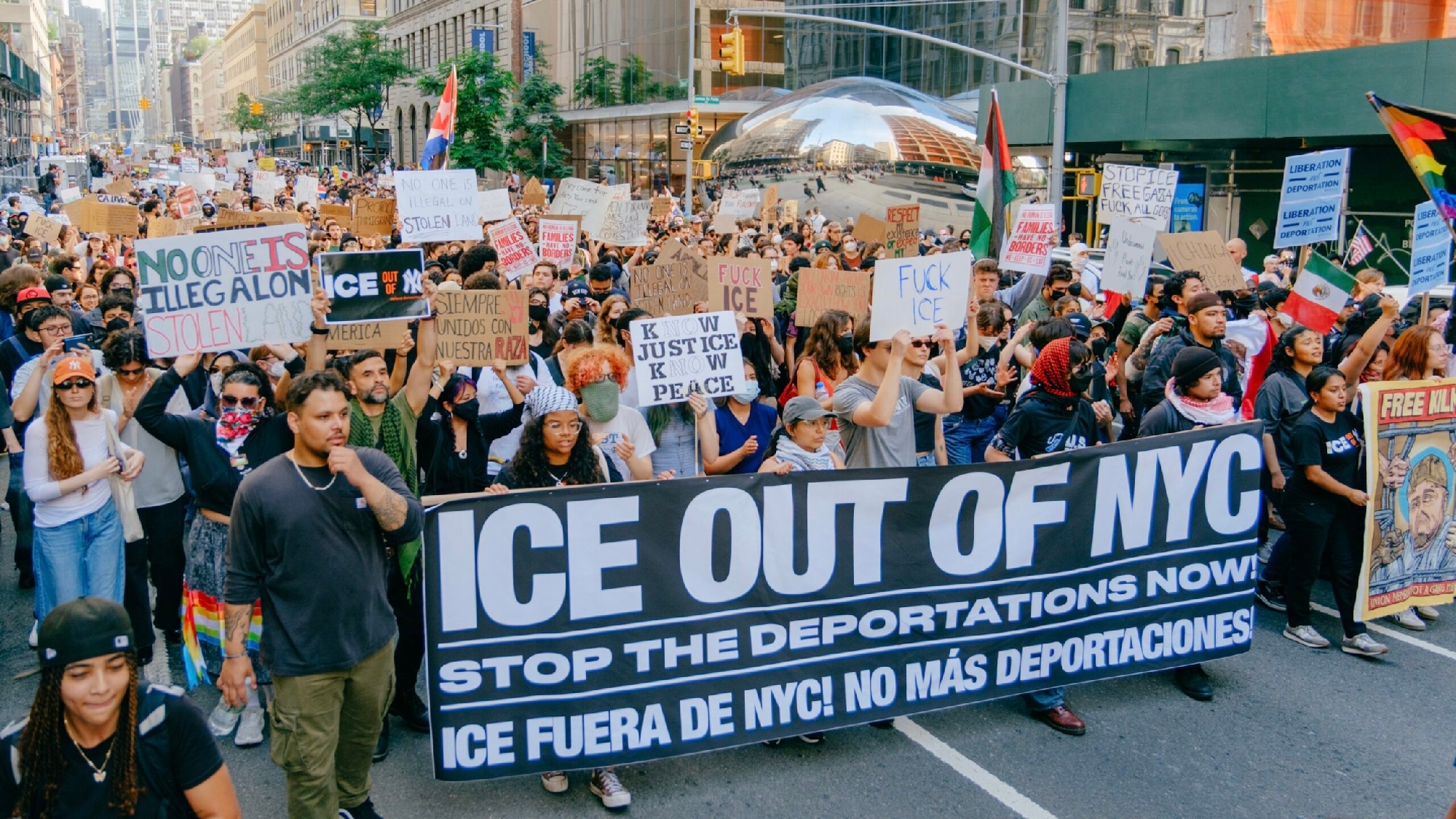 Movement against ICE raids in New York City
Photo © Peoples Dispatch
Reactions from Americans and Immigrant Communities
Immigrant communities and human rights organizations have raised concerns that aggressive raids and deportations can create fear among families and disrupt local communities. Across the country, large scale workplace raids and detention operations have sparked protests. The American Civil Liberties Union (ACLU) has also warned that overly aggressive enforcement can lead to racial profiling and wrongful detention. Such concerns have fueled widespread protests and political debates, and in January 2026, thousands of demonstrators gathered in Minnesota to oppose expanded ICE operations and deportation policies, illustrating growing tensions between federal authorities and local communities.
Historical Perspectives and Ongoing Debate
The historical identity of the United States itself forms another layer of the debate. Critics of strict immigration enforcement often point out the country’s complex history of colonization and displacement.
Indigenous communities lived across the continent long before European settlers arrived, and in light of this history, some activists argue that modern immigration policies should more carefully consider the nation’s origins in migration and territorial expansion.
This perspective does not necessarily reject immigration laws altogether but raises broader questions about national responsibility, identity, and how a country should treat those seeking a new life.
An Endless Debate
As immigration continues to shape politics across the Americas, the debate surrounding ICE is unlikely to subside. For some, the agency represents law, order, and national security. For others, it symbolizes a system that targets vulnerable communities. The challenge of balancing border enforcement with human rights will likely remain one of the most important issues in the years to come.
Reporter
Hyeonseon Namgung
namgung0121@seoultech.ac.kr


 Comment 0
 Posts containing profanity or personal attacks will be deleted
 HOME
HOME



 LUPIC: Connection Beyond Study
 Study Korea 300K Project
 From Pen to Page
 Europe’s Summer of Extreme Heat
 In Crisis: Commerce in Gongneung-dong